
Views: 1263
Last visit: 2026-10-24 05:16:31
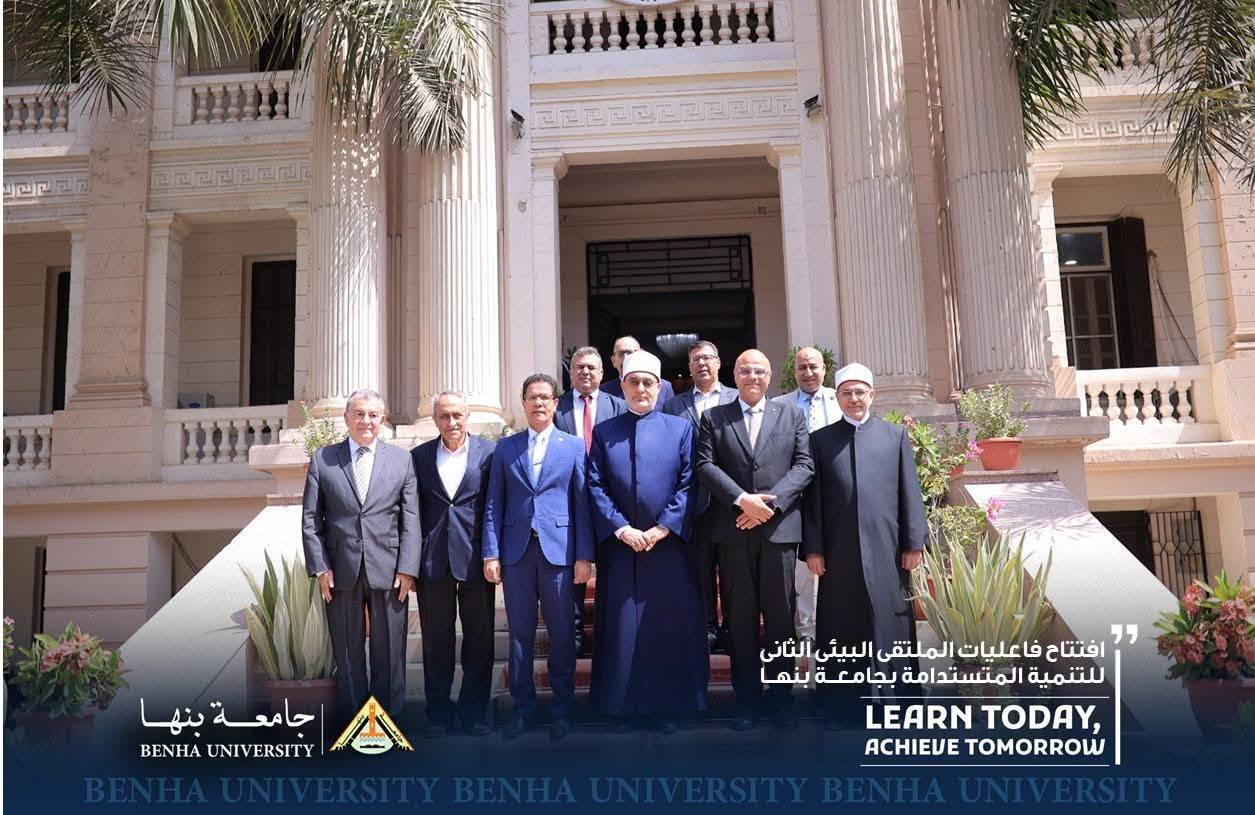
Prof. Nazir Ayad, the Grand Mufti of the Republic and Head of the General Secretariat for Fatwas in the World, along with Engineer Ayman Attia, the Governor of Kalyobiya, and Prof. Nasser El Gizawy, President of Benha University, inaugurated the activities of the second environmental forum for sustainable development titled "From Scarcity to Sustainability: Challenges and Solutions."
The event was attended by:
• Prof. Salama Gomaa Dawood, President of Al-Azhar University;
• Prof. Ayman Farid Abu Hadid, former Minister of Agriculture;
• Prof. Ali Shams El-Din, former President of Benha University;
• Prof. El Sayed Fouda, Vice President for Community Service and Environmental Development;
• Prof. Jehan Abdel Hadi, Vice President for Postgraduate Studies and Research;
• Representatives from universities (Cairo, Ain Shams, Helwan),
• Representatives from Al-Azhar and the Ministry of Awqaf in Kalyobiya, as well as academic and administrative leaders from the university.
Prof. Nazir Ayad emphasized that the meeting hosted by Benha University, under the auspices of the Greater Cairo Universities Alliance, comes at a crucial time, calling for kindness in dealing with the blessings bestowed by God upon humanity, based on His saying: "If you are grateful, I will surely increase your favor; but if you deny, indeed, My punishment is severe."
The Grand Mufti added that the environment, by its nature and social context, is fundamental to human existence, and that humans, whom God created and honored, often become ungrateful for this blessing, contradicting the law of subjugation established by God.
He pointed out that a proper understanding of the law of subjugation requires preserving the environment and transferring blessings and resources from one generation to another without wastefulness or extravagance, citing His saying: "And eat and drink, but be not excessive," and the Prophet Muhammad's saying: "Do not waste water, even if you are at a running river," as well as: "Indeed, the wasteful are brothers of the devils."
The Mufti affirmed that preserving the environment is not limited to followers of a specific religion but is a comprehensive human duty, referencing His saying: "Indeed, I am making upon the earth a successor," and noting that the current environmental crisis reflects a deep gap between what God intended for humanity in terms of stewardship of the earth and the behavior that has emerged.
He emphasized that humans face two fundamental challenges: the continuity of work and the quality of work, based on His saying: "Indeed, those who have believed and done righteous deeds - their Lord will guide them because of their faith." He stressed that faith cannot be separated from action, and that effectively investing in natural resources and fulfilling the rights of future generations represents a heavy trust, citing His saying: "And Allah presents an example of a city that was safe and secure; its provision came to it in abundance from every place, but it denied the favors of Allah, so Allah made it taste the garment of hunger and fear."
The Mufti highlighted the efforts of the Egyptian Dar Al-Ifta in promoting environmental religious awareness through issuing environmental fatwas, participating in related events, and collaborating with universities and specialized research centers like Nile University and others.
He also announced the launch of several important initiatives, including qualitative awareness programs to spread the culture of preserving natural resources in partnership with universities and environmental entities, supporting national initiatives related to sustainable development, integrating concepts of environmental sustainability into educational curricula, and enhancing the role of environmental fatwas in maintaining ecological balance and natural resources.
Engineer Ayman Attia, Governor of Kalyobiya, affirmed that Egyptian universities are committed to their national role by adopting environmental and community issues, which is reflected in organizing such events that contribute to raising awareness and enhancing efforts to achieve sustainable development.
Engineer Attia expressed his gratitude to everyone who contributed to the establishment of this conference and its honorable outcome, praising the efforts made to ensure its success.
He also pointed out the significant interest of the political leadership in this file, noting that the state has established many wastewater treatment and agricultural stations to recycle and conserve water. He mentioned the largest wastewater treatment plant in the Middle East, located in Kalyobiya, known as the Yellow Mountain Station, as well as the Bahr Al-Baqar station for treating sewage in Sinai. In terms of local efforts, Kalyobiya Governorate aims to generalize the concept of sustainability by working on establishing a "biogas" station to generate clean energy from waste recycling, in collaboration with a specialized global company.
Prof. Nasser El Gizawy stated that the second sustainable development forum reflects Benha University's deep commitment to a more balanced and sustainable future. The forum, titled "From Scarcity to Sustainability: Challenges and Solutions in Water, Energy, and Food," serves as a scientific and dialogue platform that contributes to outlining a clear roadmap to address the major challenges threatening human security and the environment, especially in a world experiencing rapid population growth and climate change.
Prof. El Gizawy noted that sustainable development is no longer an option but a necessity, and our academic and societal responsibilities require us to be active in formulating solutions and providing replicable and successful models. He explained that this forum will be a serious step towards adopting effective policies and sound practices that enhance water and food security and energy sustainability.
The university president praised the Egyptian state's efforts to achieve sustainable development goals, which are manifested in "Egypt's Vision for Sustainable Development 2030." The state has adopted ambitious policies to enhance water security through desalination projects and the lining of canals, expanding clean energy through major projects, supporting modern agriculture, empowering the most vulnerable groups, and developing education and scientific research as pillars for comprehensive growth.
Prof. Nasser El Gizawy emphasized that Benha University places sustainability at the core of its strategic vision, adopting integrated policies that include sound resource management, integrating sustainability concepts into educational curricula, and encouraging research and innovation to address challenges related to energy, water, and food. He noted that the university launches many community initiatives in collaboration with both the public and private sectors and strives to transform into a green university that meets global environmental standards, thereby affirming its serious commitment to building a sustainable future for future generations.
Prof. Salama Dawood, President of Al-Azhar University, highlighted the importance of universities in achieving sustainable development goals, considering them platforms for knowledge production. He pointed out that innovation and non-conformity are keys to leadership in this era, citing Imam Al-Shafi'i's saying that imitation is servitude. He also emphasized the need for the upper hand to transform from mere rhetoric into reality in the fields of science, economy, and production, guided by the Prophet Muhammad's saying: "The upper hand is better than the lower hand."
Prof. Dawood added that Al-Azhar represents a significant civilizational value, as it is, as he said, a Nile beside the Nile, with a history of supporting neighboring peoples in times of crisis, citing His saying: "And we provide for our family and protect our brother, and we increase the measure of our camel," and the Prophet's saying to Aisha: "Be good to the neighbor of God's blessing, for when it goes away, it does not return," warning against producing a generation with less awareness or capability, which would be a judgment on the nation of regression.
Prof. El Sayed Fouda, Vice President for Community Service and Environmental Development, added that the second environmental forum reflects the reality we live in and our future aspirations, amidst a global reality where environmental challenges are increasing, raising serious questions about the future of natural resources, the viability of traditional development models, and how to transition to comprehensive sustainability that balances present needs with the rights of future generations.
Source: Sector of University President
Keywords:
Benha University © 2020 Designed and developed by portal team - Benha University