
Views: 21
Last visit: 2026-10-05 07:07:09
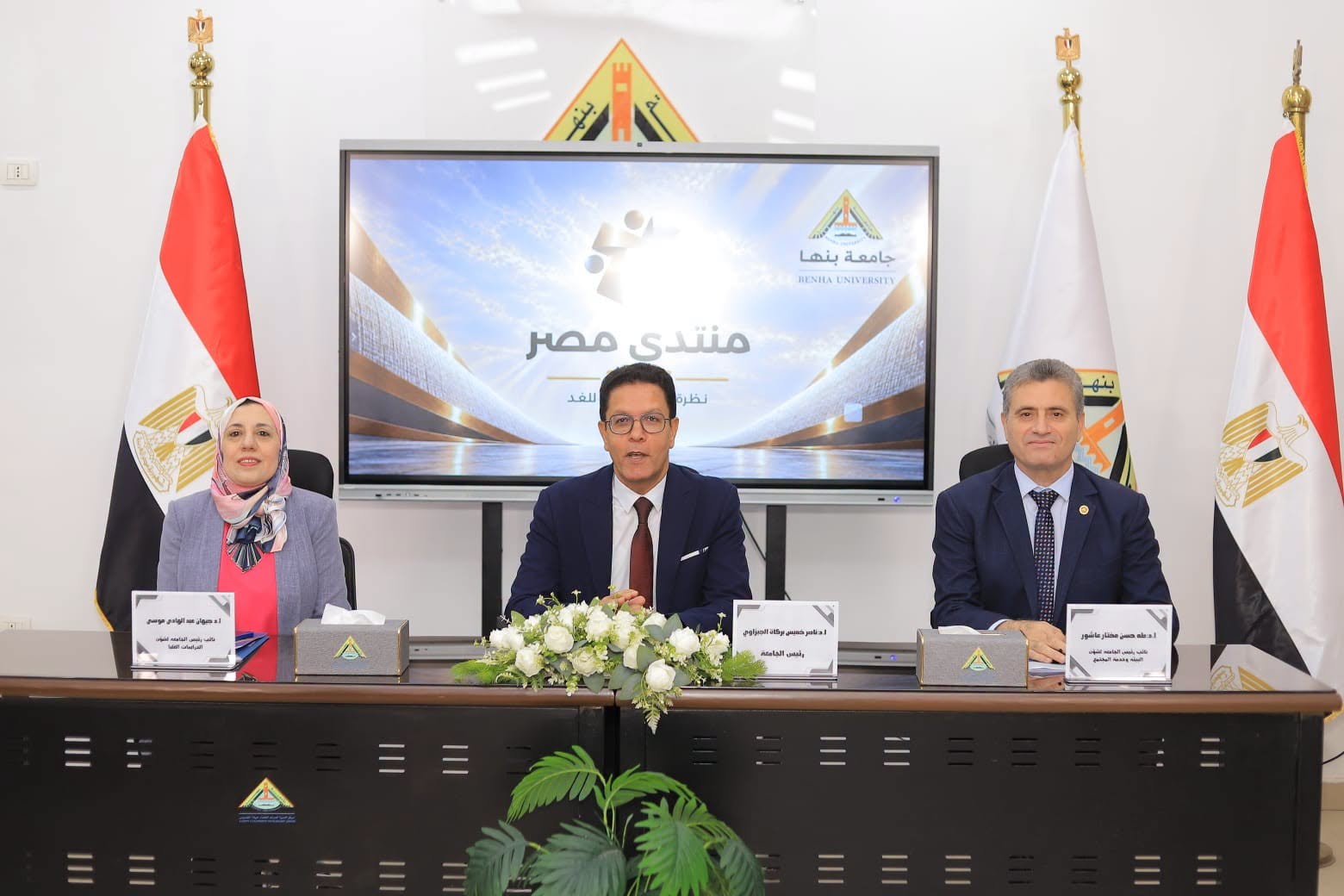
Prof. Nasser El-Gizawy, President of Benha University, chaired an extensive Discussion session focused on "Food and Water Security," as part of the university's participation in the preparatory sessions and community Discussion for Egypt Forum 2026. This initiative responds to the invitation from His Excellency President Abdel Fattah El-Sisi to open avenues for discussion on priority national issues.
The session was held under the auspices of :
• Prof. Abdel Aziz Qansoua, Minister of Higher Education and Scientific Research,
• Prof. Gehan Abdel Hady Vice President for postgraduate Studies and Research,
• Prof. Taha Ashour, Professor of Agricultural Engineering and Vice President for Community Service and Environmental Development, coordinated the session.
The Discussion session witnessed the participation of over 25 experts and specialists from Benha University in the fields of agricultural sciences, veterinary medicine, and water resources, including former university presidents:
• Prof. Ali Shams El-Din,
• Prof. Jamal El-Said,
• Prof. Jamal Sosa
• Prof. Yaqub El-Sanousi, Chairman of the Faculty Members Club at Benha University,
• selection of experts
• faculty members related to the session's topics.
Representatives from several ministries and relevant authorities also attended:
• Prof. Khaled Gad represented the Ministry of Agriculture and Land Reclamation,
• Engineer Mohamed Omar Makram represented the Ministry of Water Resources and Irrigation.
• Prof. Doaa Nabil represented the Ministry of Supply and Internal Trade,
• Prof. Sayyed Khalifa, the Syndicate of Agricultural Engineers,
highlighting the diverse expertise involved in discussing food and water security.
Prof. Nasser El-Gizawy emphasized that organizing this session stems from the university's national and scientific role and its commitment to actively participate in community Discussion regarding priority national issues. He highlighted the importance of utilizing academic and research expertise to provide practical insights and solutions to address challenges related to food and water security, supporting the state's efforts to achieve sustainable development.
Prof. El-Gizawy explained that universities possess a wealth of expertise and scientific research specializations that can be employed to serve community issues, stressing the need to enhance communication between academic institutions and executive bodies to ensure that the results of studies and scientific research are translated into applications and solutions that benefit productive sectors and support development plans.
He added that the outcomes of the session would include a set of proposals and recommendations based on the discussions and experiences shared, which will be submitted to the relevant authorities to inform the insights and proposals presented at the Egypt Forum 2026.
The session featured extensive discussions on several issues related to food and water security, including the rational use of water resources, the expansion of modern irrigation systems, and improving water efficiency in agricultural activities. Participants also discussed the expansion of agricultural technology and innovation to increase productivity and optimize resource utilization.
the participants explored ways to develop the agricultural production system, enhance supply chain efficiency, improve the processes of trading and storing strategic goods and crops, and reduce waste and loss, contributing to the efficiency of the food security system and its ability to face future challenges.
Discussions also addressed the importance of applied scientific research in tackling challenges posed by climate change by developing more sustainable agricultural techniques and methods, and finding solutions to improve productivity while rationalizing the consumption of water and energy, utilizing modern technologies and data in managing agricultural and water resources.
The session examined the importance of integration between various scientific disciplines in addressing food and water security issues, recognizing these as interconnected files requiring collaboration among agriculture, water resources, sciences, engineering, economics, and other fields to reach comprehensive and applicable insights.
Participants emphasized the need to build more effective partnerships between universities, ministries, executive bodies, and the private sector, alongside supporting the role of community associations and institutions in raising awareness of food and water security issues, promoting sustainable practices, rationalizing water consumption, reducing food waste, and supporting initiatives and projects that serve local communities.
They also highlighted that listening sessions represent an important space for exchanging experiences, presenting scientific insights, and benefiting from different experiences, which helps identify challenges and gaps, review available alternatives and solutions, and establish clear priorities for the upcoming phase.
Source: Sector of University President
Keywords:
Benha University © 2020 Designed and developed by portal team - Benha University