
Views: 92
Last visit: 2026-10-11 15:40:14
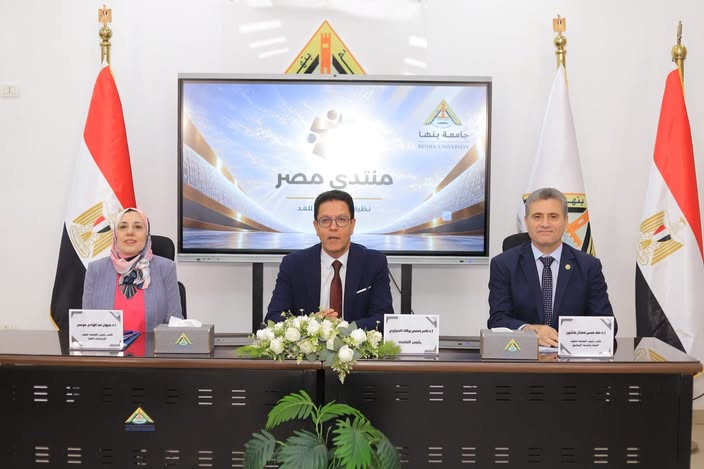
We publish the recommendations of the hearing session organized by Benha University on “Food and Water Security,” held as part of the preparations for the “Egypt Forum 2026” events.
Participants in the session recommended a set of measures aimed at strengthening food and water security in Egypt and achieving the optimal use of natural resources in support of the Sustainable Development Goals and Egypt's future vision.
First: Raising the efficiency of water use in agriculture
Expanding the application of modern irrigation systems, particularly drip and sprinkler irrigation, to reduce water losses.
Using smart technologies and modern sensors to determine the actual water requirements of crops.
Completing projects to raise the efficiency and develop canals, watercourses, and drains.
Expanding the application of digital agriculture and early-warning systems to confront drought and climate fluctuations.
Second: Maximizing the benefit from available water resources
Expanding the treatment and reuse of agricultural drainage water.
Increasing reliance on tertiary treatment plants for wastewater in agricultural activities.
Utilizing greywater in cities and new urban communities.
Considering water reuse as a major strategic resource within the water-resources management system.
Third: Shifting toward a smart crop structure
Expanding the cultivation of crops that consume less water and offer higher economic returns.
Reducing the cultivation of water-intensive crops in areas with limited resources.
Supporting programs for the breeding and development of crop varieties that tolerate drought, salinity, and high temperatures.
Fourth: Expanding water desalination using renewable energy
Increasing investment in seawater desalination projects to meet the needs of new cities and coastal areas.
Linking desalination plants to solar and wind energy sources to reduce operating costs.
Supporting the localization of the desalination-plant components industry and developing related industries.
Fifth: Protecting agricultural land and increasing productivity
Tightening measures to protect agricultural land and prevent encroachments upon it.
Expanding protected agriculture and greenhouse farming.
Strengthening the role of agricultural extension services and developing the services provided to farmers.
Increasing agricultural productivity per unit of land and water through the use of modern technologies.
Sixth: Reducing food loss and waste
Establishing modern centers for collection, sorting, and refrigeration.
Developing supply chains and refrigerated transport for agricultural products.
Expanding the construction of silos and modern storage facilities.
Promoting a culture of rational consumption and reducing food waste.
Seventh: Strengthening strategic food security
Increasing the strategic stock of basic food commodities.
Diversifying import sources to reduce risks associated with global markets.
Supporting contract-farming systems linking producers, processors, and consumers.
Encouraging local food industries and raising their competitiveness.
Eighth: Expanding sustainable desert agriculture
Expanding agricultural reclamation projects based on accurate studies of groundwater aquifers.
Using solar energy to operate water wells and pumping systems.
Ensuring the application of modern irrigation systems in newly reclaimed lands.
Relying on crops suited to desert and arid environments.
Ninth: Confronting the impacts of climate change
Developing crop varieties resistant to heat and drought.
Establishing and updating early-warning systems for disasters and climate fluctuations.
Taking the necessary measures to protect the Nile Delta from the effects of rising sea levels.
Expanding afforestation programs, desertification control, and the improvement of vegetation cover.
Tenth: Developing governance and legislation
Creating a unified national database for the water, agriculture, and food sectors.
Developing economic policies that encourage the rational use of water while taking into account the social dimension for small-scale farmers.
Strengthening integration and coordination among the entities responsible for managing water resources and food production.
Encouraging private-sector participation in water, food, and agricultural investment projects.
Proposed Strategic Vision up to 2050
The session affirmed that achieving food and water security in Egypt requires action based on five fundamental pillars:
Efficient use of every drop of water.
Increasing productivity per feddan with less water.
Expanding the reuse of treated water.
Reducing food loss and waste across all stages of production and distribution.
Relying on modern technology, renewable energy, and scientific research as the main pillars of sustainability.
Participants emphasized that the integrated implementation of these recommendations will contribute to enhancing Egypt's capacity to confront the challenges of population growth and climate change, and to ensuring the sustainability of resources for future ge
Source: Sector of University President
Keywords:
Benha University © 2020 Designed and developed by portal team - Benha University